Hamilton & Chase Tours
Sardinia: Island & Ancient Stone — Bespoke 8-day Italy tour: Nuraghi, flamingos, turquoise sea, and a table that Rome never simplified.

8-Day Bespoke Journey

Sardinia: Island & Ancient Stone

Nuraghi, flamingos, turquoise sea, and a table that Rome never simplified.

Available as Private Semi-Private Self-Guided
From €3,690 per person 8 days / 7 nights
View Itinerary

Tour Overview

8 days across Italy.

Sardinia is one of the Mediterranean's great unsolved mysteries. The island has been inhabited since the Neolithic, produced a Bronze Age civilisation — the Nuragic — that built over seven thousand stone towers across its landscape for reasons that archaeologists still debate, and has been occupied by Phoenicians, Carthaginians, Romans, Arabs, Catalans, and finally mainland Italians without being fundamentally altered by any of them. The result is an island with its own language, its own cuisine, its own traditions, and a geography that moves from the pink granite of the Costa Smeralda to the wetlands of the Oristano lagoon where pink flamingos winter in their thousands, to the volcanic plateau of the Barbagia interior where villages still hold ceremonies that predate Christianity. This eight-day private journey covers the island's most extraordinary contrasts: ancient stone, turquoise sea, and a table that Rome has never been able to simplify.

Detailed Itinerary

Your journey, day by day.

Every day is designed with breathing room. Sleep in, take a detour, linger at lunch — the itinerary flexes around you, not the other way around.

Day 1 — Cagliari: The Phoenician Port
Day 1
1

Day 1

Cagliari: The Phoenician Port

The oldest continuously inhabited city in the western Mediterranean.

Cagliari was founded by the Phoenicians in the 8th century BC and every subsequent civilisation added its layer — the Carthaginian acropolis that became the Roman forum, the Byzantine towers that the Catalans converted into Pisan-Romanesque churches, the Spanish Baroque that covers the upper city. Your private driver meets you at Cagliari Elmas airport and delivers you to your hotel in the Castello district — the walled upper city — whose views take in the harbour, the lagoon, and on clear evenings the silhouette of the Sulcis mountains to the southwest. The afternoon at leisure: the Viale Regina Elena promenade above the lagoon, where flamingos are often visible feeding in the shallows from late summer onward. Dinner in the Marina district below the Castello: the cuisine of Cagliari is the most cosmopolitan on the island — bottarga (dried mullet roe, shaved over pasta), fregola with clams, culurgiones (Sardinian stuffed pasta) — with the local Vermentino di Sardegna.

  • Private transfer to Cagliari's walled Castello district
  • Viale Regina Elena promenade — flamingos in the lagoon
  • Cagliari harbour panorama at dusk
  • Cagliari cuisine: bottarga, fregola, culurgiones
5★ hotel, Cagliari Castello district
Day 2 — The Nuragic Civilisation
Day 2
2

Day 2

The Nuragic Civilisation

Seven thousand stone towers and no written explanation.

The Nuragic civilisation built its characteristic stone towers — nuraghi — between 1800 and 500 BC across every part of Sardinia. Over seven thousand survive. Nobody fully understands why they were built: defensive towers, ritual spaces, astronomical observatories, or status symbols — or all of these simultaneously. The Nuraghe Su Nuraxi at Barumini is the most extensive and best-preserved: a central tower of rough-cut basalt surrounded by four secondary towers and a village of stone huts that was inhabited for fifteen hundred years. Your private guide — an archaeologist from the Cagliari excavation teams — explains the construction techniques, the social organisation implied by the layout, and the extraordinary fact that the Nuragic people left no written language, only objects. The afternoon at the nearby village of Las Plassas, where a Nuragic-era menhir alignment on a hilltop predates the nuraghi by a thousand years. Dinner at an agriturismo in the Marmilla region.

  • Nuraghe Su Nuraxi — UNESCO World Heritage Site with archaeologist guide
  • Nuragic village of stone huts — 15 centuries of continuous habitation
  • Las Plassas menhir alignment
  • Marmilla agriturismo dinner
Meals: Breakfast 4★ agriturismo or hotel, Marmilla / Oristano area
Day 3 — Oristano: The Sinis Peninsula
Day 3
3

Day 3

Oristano: The Sinis Peninsula

Pink flamingos, Phoenician ruins, and the best beaches nobody knows.

The Sinis Peninsula west of Oristano is one of Sardinia's least-visited areas and one of its most extraordinary. The Stagno di Cabras lagoon — one of the largest coastal lagoons in the Mediterranean — shelters fifteen thousand pink flamingos in winter and thousands more in summer migration, along with herons, spoonbills, and the mullet that produce the bottarga for which Cabras is internationally known. A private boat on the lagoon for the morning birdwatching. The Phoenician and Carthaginian site of Tharros on the tip of the peninsula: columns from the Roman forum standing above the sea, Phoenician graves in the rock, and a Punic tophet visible below the waterline. The white sand beach of Is Arutas in the afternoon: grains of pure quartz white against turquoise water, entirely uncommercialised, with views of the offshore basalt stacks. Dinner in Cabras: the bottarga restaurant that sells its product to every serious Italian restaurant and keeps the best portions for local plates.

  • Flamingo birdwatching by private boat on Stagno di Cabras
  • Tharros Phoenician ruins above the sea
  • Is Arutas quartz beach — turquoise water and basalt stacks
  • Bottarga dinner in Cabras
Meals: Breakfast 4★ hotel, Alghero
Day 4 — Alghero: Catalan Sardinia
Day 4
4

Day 4

Alghero: Catalan Sardinia

The city that speaks Catalan and cooks with sea urchin.

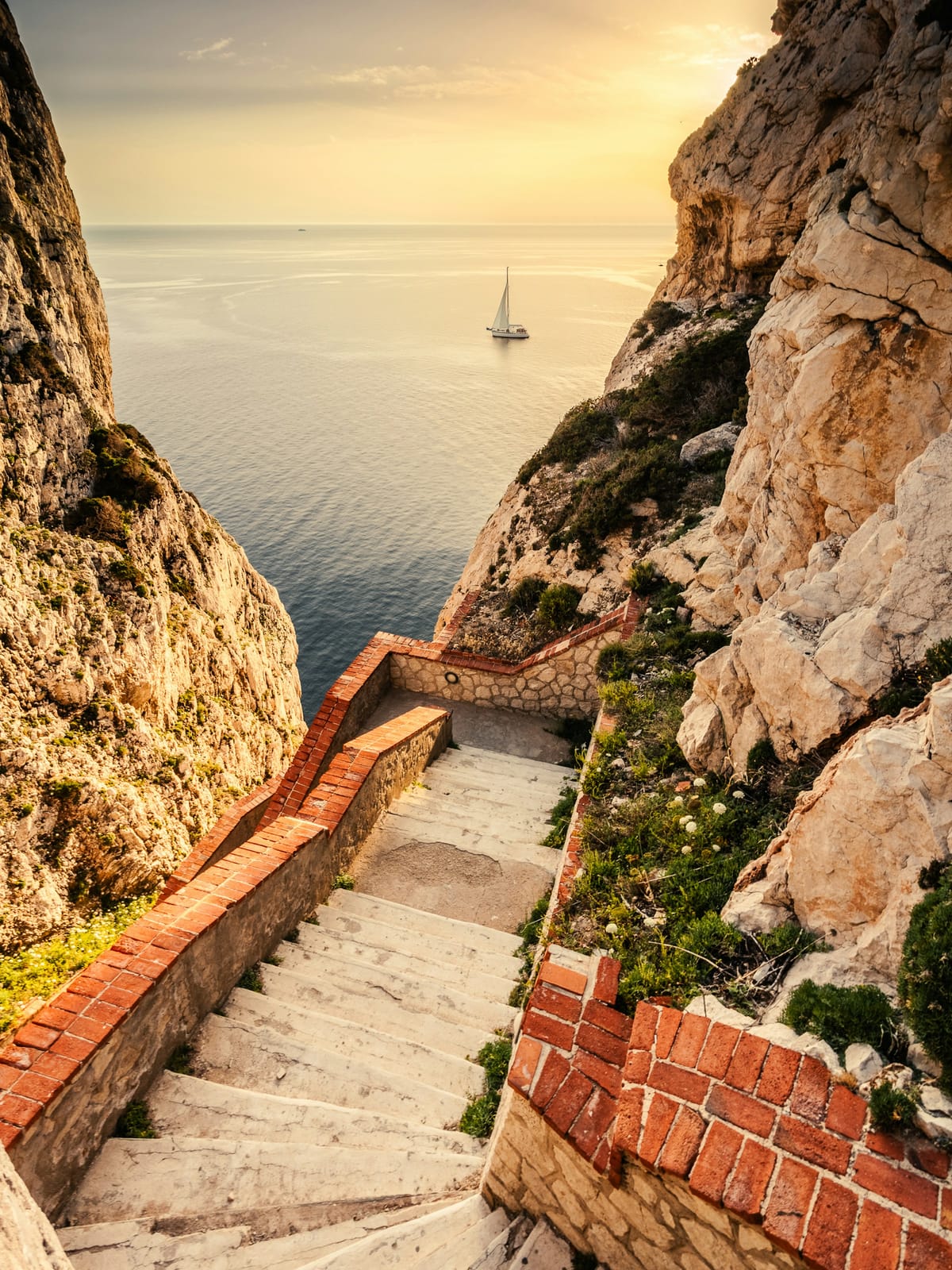
Alghero was founded by the Catalans in the 14th century and the dialect spoken here — Algherese — is closer to the Catalan of Barcelona than to Sardinian or Italian. The walled old city on its promontory above the sea is one of the most architecturally coherent medieval towns in Sardinia: Catalan Gothic churches, Spanish Baroque palazzi, and the 16th-century towers of the sea walls still fully intact. A morning walk with a local guide through the narrow streets — the fish market, the sea urchin vendors who work the morning tide, the churches, and the view from the towers. In the afternoon, Neptune's Grotto: a sea cave accessible either by boat from Alghero harbour or by the 654-step staircase cut into the cliff face (the Escala del Cabirol — 'the chamois staircase'). The cave system extends for four kilometres and contains stalactite formations of extraordinary scale. Dinner in Alghero: sea urchin (ricci di mare) on pasta, aragosta alla catalana — Sardinian lobster prepared in the Catalan style with tomato and onion.

  • Alghero old city — Catalan Gothic in a Sardinian setting
  • Sea walls and medieval towers
  • Neptune's Grotto by boat — four-kilometre cave system
  • Sea urchin pasta and aragosta alla catalana
Meals: Breakfast 5★ hotel, Alghero
Day 5 — The Costa Smeralda
Day 5
5

Day 5

The Costa Smeralda

Where the Aga Khan built an idea of Italy in the 1960s.

The Costa Smeralda was a stretch of uninhabited granite coast until 1962, when the Aga Khan purchased 5,500 hectares of it and commissioned architects to build a resort that maintained the character of Sardinian vernacular architecture while providing luxury on a level that would attract European royalty and international society. The result — the Porto Cervo complex, the Cala di Volpe hotel, the Hotel Romazzino — is a genuine architectural achievement and remains, despite the socialites and superyachts, one of the most visually consistent resort areas in the Mediterranean. Your private driver takes you through the landscape: the pink granite boulders smoothed by millennia of wind, the juniper maquis, the extraordinary turquoise water of the Cala del Principe beach. An afternoon at one of the Costa's private beach clubs — the kind that the hotel concierge arranges, where the umbrella placement ensures privacy and the fish lunch is caught that morning.

  • Costa Smeralda's Aga Khan-designed resort architecture
  • Cala del Principe beach — pink granite and turquoise water
  • Private beach club access
  • Sardinian granite maquis landscape
Meals: Breakfast 5★ hotel, Costa Smeralda / La Maddalena area
Day 6 — La Maddalena Archipelago
Day 6
6

Day 6

La Maddalena Archipelago

A naval base and a national park, simultaneously.

The La Maddalena Archipelago is a national park of forty-three islands and islets in the Straits of Bonifacio between Sardinia and Corsica — a marine environment of extraordinary clarity where the water changes colour across the blue-to-turquoise spectrum depending on depth and substrate. A private boat from La Maddalena takes you through the archipelago: the island of Spargi, whose Cala Corsara beach has water of impossible clarity; Budelli, whose Rosa beach was once a registered natural monument for the pink-tinted sand composed of fragments of coral and microscopic organisms; the islet of Santo Stefano, where Napoleon was briefly imprisoned in 1793. Swimming stops at two or three beaches through the day. Lunch on board. The afternoon returns to La Maddalena town: the 18th-century fortifications that Garibaldi used as a base, the house at Caprera where he lived in voluntary exile after the Risorgimento, and the little ferries that connect the inhabited islands at dusk.

  • Private boat through the Maddalena Archipelago national park
  • Cala Corsara and Budelli swimming stops
  • Straits of Bonifacio — Sardinia and Corsica facing each other
  • Garibaldi's house at Caprera
Meals: Breakfast 5★ hotel, La Maddalena area
Day 7 — Return South: The Barbagia Villages
Day 7
7

Day 7

Return South: The Barbagia Villages

The Sardinia that modernisation has not reached.

The Barbagia is the mountainous interior of Sardinia — the area that the Romans never fully controlled and that has maintained a culture distinct from the coastal towns. The villages of Orgosolo are known for their political murals — hundreds of extraordinary frescoes painted on the exterior walls of every building in the village since the 1970s, forming the most complete open-air museum of political and social documentary art in Italy. The nearby village of Oliena produces Cannonau di Sardegna in the most concentrated form — a wine with extraordinary depth and the kind of polyphenol content that has made Sardinia's interior part of a global longevity study. A private tasting at a small Oliena producer: Cannonau and the local Nepente di Oliena, a dessert wine made from semi-dried Cannonau grapes that was supposedly served to D.H. Lawrence during his visit. Return to Cagliari for a final dinner.

  • Orgosolo mural village — the most complete open-air political art in Italy
  • Oliena Cannonau tasting — the longevity wine of the Blue Zone
  • Nepente di Oliena dessert wine
  • Return to Cagliari for final evening
Meals: Breakfast 5★ hotel, Cagliari
Day 8 — Departure
Day 8
8

Day 8

Departure

The island does not encourage easy departure.

Your last Sardinian morning. The Cagliari market at the Bastione San Remy has the island's best provisions — bottarga vacuum-packed for travel, mirto (myrtle berry liqueur), the pane carasau flatbread that lasts for months and travels perfectly, the Cannonau and Vermentino that won't taste the same when drunk elsewhere. Your private driver transfers you to Cagliari Elmas at the agreed time. Sardinia has a quality that is difficult to explain to people who haven't been — a sense that the island is not quite inside the Mediterranean that surrounds it, and is consequently doing something entirely its own.

  • Cagliari market provisions — bottarga, mirto, pane carasau
  • Private transfer to Cagliari Elmas airport
Meals: Breakfast

Where You'll Stay

Hand-picked hotels, every night.

We choose properties for character, location, and the kind of service that makes you feel looked after — not just checked in. Every hotel can be swapped for an alternative if you prefer.

5★ hotel, Castello district, Cagliari

Cagliari

1 night

5★ hotel, Castello district

Walled upper city

Views of the harbour, lagoon, and city walls

4★ agriturismo or hotel, Marmilla / Oristano

Marmilla / Oristano

1 night

4★ agriturismo or hotel

Central Sardinia

Close to the nuraghi sites and the Sinis Peninsula

5★ hotel, Alghero

Alghero

2 nights

5★ hotel

Old city or seafront

The old city has limited options — we work with the best available within the walls

5★ hotel, Costa Smeralda / La Maddalena

Costa Smeralda / La Maddalena

2 nights

5★ hotel

Costa Smeralda or La Maddalena island

Specific property depends on season and availability — we use the leading properties in this area

5★ hotel, Cagliari

Cagliari

1 night

5★ hotel

Historic centre or waterfront

Final night before departure

Hotels shown are indicative of the standard we book. Upon request, we will provide a detailed itinerary with specific hotel options tailored to your preferences and budget.

What's in the Price

Included

  • 7 nights in 4–5★ hotels and agriturismo
  • Daily breakfast at your hotel
  • Nuraghe Su Nuraxi private guided visit with archaeologist
  • Private boat on the Stagno di Cabras lagoon
  • Neptune's Grotto boat access
  • Private boat through the Maddalena Archipelago
  • All private vehicle transfers
  • All entrance fees for included sites
  • 24/7 travel specialist support
  • Hamilton & Chase digital travel booklet with island cultural guide

Not Included

  • Flights to/from Sardinia
  • Travel insurance (required — we can arrange on request)
  • Meals not listed
  • Personal expenses and provisions purchased at market
  • Gratuities for guides, drivers, and boat captains

Good to Know

  • July and August are extremely busy on the Costa Smeralda — prices rise significantly and the best accommodations book a year in advance. May–June and September–October offer warm water, emptier beaches, and lower costs.
  • The flamingo season at Oristano peaks in winter (November–March) with up to 15,000 birds; summer visits see smaller but still significant populations.
  • Sardinia is served by international flights to Cagliari, Olbia (closest to La Maddalena), and Alghero — the itinerary can begin or end at any of these.
  • The interior Barbagia roads are narrow and mountainous — journey times should be padded generously.

Make It Yours

Optional add-ons & upgrades.

Every trip is different. These extras can be woven into your itinerary — just let your travel specialist know what catches your eye.

Sella del Diavolo sunset hike

The promontory above Cagliari's Poetto beach — a 45-minute evening walk to the headland with 360-degree views of the coast and the city

Price on Request

Corsica day trip from La Maddalena

A private boat to Bonifacio in southern Corsica — the cliff-top citadel visible from Sardinia, French Corsican cuisine, and the Straits of Bonifacio from the Corsican side

Price on Request

Su Gorroppu canyon trek

One of Europe's deepest gorges, in the Supramonte of Orgosolo — a half-day guided trek through the canyon with a naturalist

Price on Request

Cagliari seafood cooking class

A morning class with a Cagliari chef: bottarga, fregola con arselle, culurgiones — the three preparations that define the Cagliari table

Price on Request

"The nuraghe visit with the archaeologist changed how we understood the island completely. And the flamingo lagoon the next morning — fifteen thousand birds in the mist. We had expected beaches. We had not expected anything like this."

François & Isabelle M.

Paris, France · Sardinia: Island & Ancient Stone, September 2024

Common Questions

Questions about this trip.

How does Sardinia differ from mainland Italy?

Quite significantly. The food, language (Sardinian is a separate Romance language from Italian), traditions, and even the pace of life are distinct. The nuraghi have no mainland equivalent. The cuisine uses ingredients — bottarga, pane carasau, mirto, Cannonau — that don't exist in Italian cooking elsewhere. It rewards guests who come curious rather than expecting Italy.

What is the best time for the beaches?

The water is warm from June through October. The best combination of warm water, empty beaches, and cooler air temperature is September — the Sardinian summer ends later than the rest of Italy and the Costa Smeralda empties rapidly after the first week of September.

Bespoke Journey

Sardinia: Island & Ancient Stone

8 days / 7 nights

From €3,690

per person

Ready to go?

Share a few details and a specialist will reply within one business day.

More Italy Tours

Prefer to Talk?

Available Mon–Fri 9am–6pm CET.
On-trip support is 24/7.

Plan My Trip