Hamilton & Chase Tours
Swiss Alps — Private Package 8-day Switzerland tour: The Bernese Oberland, the Glacier Express, Zermatt, and the Engadin plateau.

8-Day Private Package Journey

Swiss Alps

The Bernese Oberland, the Glacier Express, Zermatt, and the Engadin plateau.

Available as Private Semi-Private Self-Guided
From €3,290 per person 8 days / 7 nights
View Itinerary

Tour Overview

8 days across Switzerland.

The Swiss Alps are not one landscape. The Bernese Oberland — with the Eiger, Mönch, and Jungfrau above the green valley — has a cultivated, accessible grandeur that made it the birthplace of modern Alpine tourism in the 19th century. The Valais — Zermatt and the Matterhorn — is starker, more elemental, with a Mediterranean influence from the south that produces warm autumn days and the driest air in Switzerland. The Engadin — St. Moritz and the high plateau above the Inn valley — is a different country entirely: a Romansh-speaking world of clarity and light that explains why artists and writers have been coming to the Upper Engadin for two centuries. The Glacier Express — the slowest express train in the world — connects Zermatt to St. Moritz in eight hours of extraordinary scenery. This eight-day private journey uses all three regions and the train that connects two of them.

Detailed Itinerary

Your journey, day by day.

Every day is designed with breathing room. Sleep in, take a detour, linger at lunch — the itinerary flexes around you, not the other way around.

Day 1 — Zurich: Arrival and the River City
Day 1
1

Day 1

Zurich: Arrival and the River City

Switzerland's largest city — and the one with the best art.

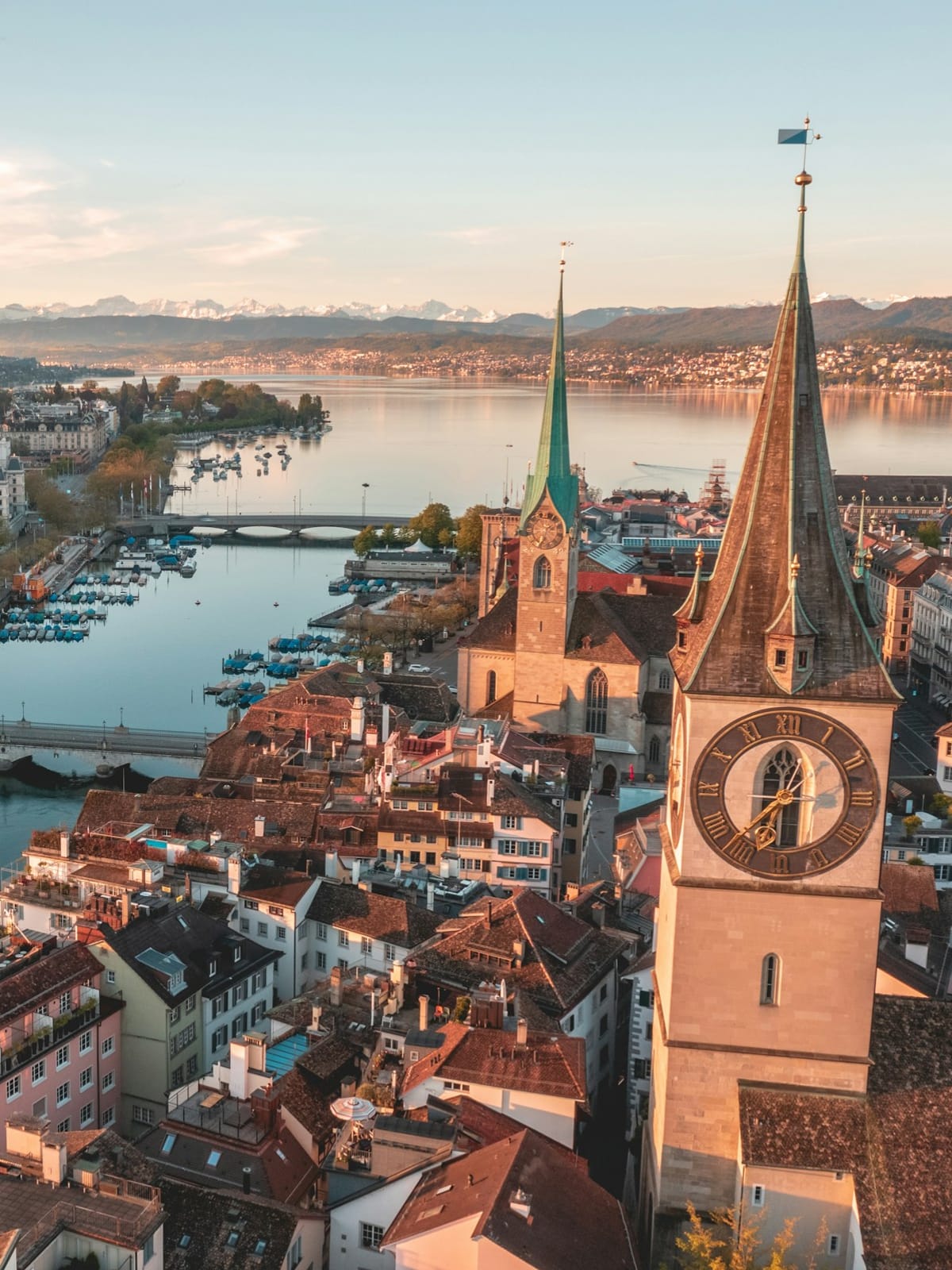
Zurich's Altstadt sits on both banks of the Limmat where it flows out of the lake, and the quality of light over the water on a clear afternoon — with the Alps visible to the south — makes it immediately apparent why the Swiss arranged their city this way. Your private driver meets you at the airport. The afternoon at leisure: the Grossmünster's twin Romanesque towers, the Fraumünster's five Chagall windows, the Kunsthaus expansion by architect David Chipperfield that opened in 2021 and made Zurich's art museum the largest in Switzerland. The Zurich lake promenade in the evening: the Bellevue square, the Limmatquai with its guild houses, the Niederdorf quarter where the restaurants and bars are in medieval buildings above the river. Welcome dinner at a restaurant in the Altstadt — fondue or Zürcher Geschnetzeltes, the veal-in-cream-sauce dish that Zurich invented and does better than anywhere else.

  • Private airport transfer
  • Fraumünster — Marc Chagall's windows
  • Kunsthaus Zurich — the largest art museum in Switzerland
  • Limmatquai guild houses and Niederdorf evening
4–5★ hotel, Zurich centre
Day 2 — The Bernese Oberland: Arrival in the Alps
Day 2
2

Day 2

The Bernese Oberland: Arrival in the Alps

The valley below the Eiger, Mönch, and Jungfrau.

The drive south from Zurich to the Bernese Oberland takes ninety minutes and crosses the Mittelland plateau before the Alps appear ahead with the characteristic abruptness of the Swiss pre-Alps — one moment you are in rolling farmland, the next the Eiger's north face is occupying the entire southern horizon. Interlaken is the gateway town, between the Thunersee and the Brienzersee, with the Höheweg promenade looking directly at the Jungfrau massif. From Interlaken, the valley splits: east to Grindelwald below the Eiger, or south to Wengen and Mürren on the mountain terraces above. Your hotel is positioned for the views. The afternoon for acclimatisation: a walk in Grindelwald's valley, the first ride on a gondola to a viewpoint above the treeline, or simply the experience of sitting opposite the north face of the Eiger — the 1,800-metre wall of limestone that was the most feared challenge in alpinism from 1935 to 1938, when it was first climbed.

  • Drive through the Mittelland to the Alps
  • First view of the Eiger north face
  • Interlaken and the Höheweg promenade
  • Afternoon gondola above the valley
Meals: Breakfast 4–5★ hotel, Grindelwald or Wengen
Day 3 — Jungfraujoch and the First View of the Aletsch
Day 3
3

Day 3

Jungfraujoch and the First View of the Aletsch

3,454 metres. The longest glacier in the Alps. The most extraordinary railway in the world.

The Jungfrau Railway bores through the limestone of the Eiger and Mönch for seven kilometres before emerging above the cloud at 3,454 metres — a feat of engineering completed in 1912 that still takes approximately fifty minutes to absorb on the way up. The window stations in the Eigerwand (Eiger Wall) and Eismeer (Sea of Ice) open directly onto the north face of the Eiger, where the stone plunges 1,700 metres to the valley below. At the Jungfraujoch: the Sphinx Observatory at 3,571 metres (reachable by lift), the Ice Palace carved from the glacier, and the view south across the Aletsch Glacier — 23 kilometres long and 900 metres deep at its thickest, the largest glacier in the Alps and a UNESCO World Heritage Site. Your private guide has been leading Jungfraujoch excursions for fifteen years and explains the geology of the Aletsch and the history of the railway. Descent to the valley for lunch. Afternoon walk in Grindelwald First — the high meadow plateau above the village, reached by gondola, with views of the Wetterhorn and the Schreckhorn.

  • Jungfraujoch railway — window stations inside the Eiger
  • Sphinx Observatory at 3,571 metres
  • Aletsch Glacier UNESCO World Heritage Site
  • Grindelwald First afternoon — high meadow above the treeline
Meals: Breakfast 4–5★ hotel, Grindelwald or Wengen
Day 4 — Schilthorn: The Other Peak
Day 4
4

Day 4

Schilthorn: The Other Peak

The revolving summit where James Bond was defeated, and the finest panorama in the Bernese Oberland.

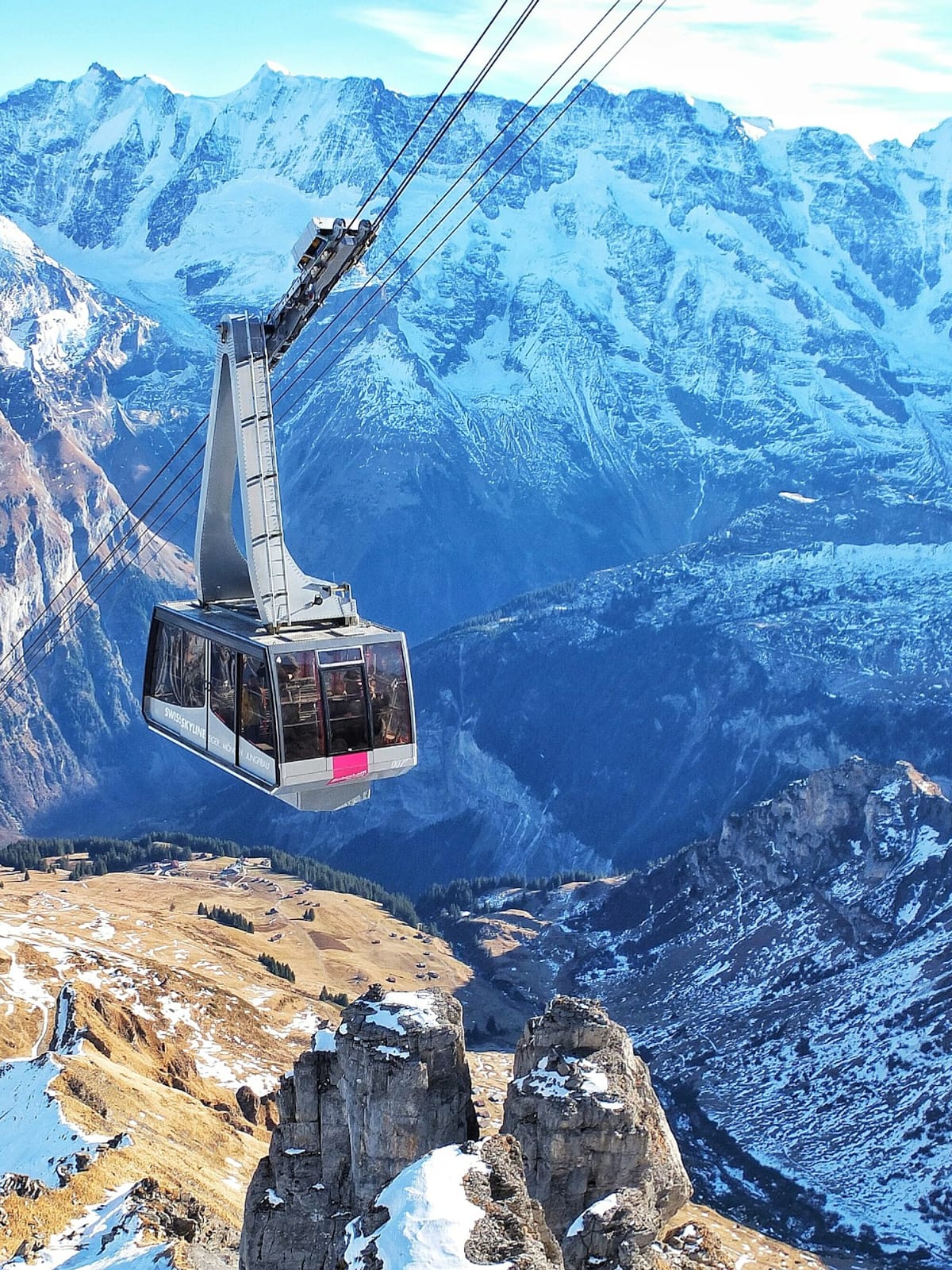
The Schilthorn at 2,970 metres is reached by a sequence of four cable cars from the valley — from Stechelberg via Gimmelwald and Mürren to the summit. Mürren, on a high terrace of the cliff face above the Lauterbrunnen valley, is car-free and has been since long before Zermatt — a cluster of wooden chalets in a position that looks directly across at the Jungfrau massif at the same altitude. The Piz Glorja revolving restaurant at the Schilthorn summit was the villain's lair in On Her Majesty's Secret Service (1969) and has been trading on this fact ever since, but the panorama — 200 Alpine peaks from Mont Blanc to the Grossglockner — would make it the right place for a lunch regardless. Afternoon return to the Bernese Oberland before the transfer toward Zermatt via Brig. The Rhône valley narrows as you head south into the Valais — a different canton, a different landscape, and notably warmer.

  • Four cable cars to the Schilthorn at 2,970 metres
  • Mürren — the car-free village on the cliff terrace
  • Piz Glorja — James Bond's summit and 200 Alpine peaks
  • Transfer south through the Rhône valley to Zermatt
Meals: Breakfast 4–5★ hotel, Zermatt
Day 5 — Zermatt: Below the Matterhorn
Day 5
5

Day 5

Zermatt: Below the Matterhorn

The mountain that became a symbol, and the village that served it.

Zermatt has been car-free since 1930 and the effect — combined with the Matterhorn's silhouette above every roofline — is of a village that exists in its own time. The Matterhorn is not the highest mountain in the Alps (Monte Rosa across the valley beats it by nearly 200 metres) but it is the most recognised. Edward Whymper's first ascent in 1865 and the four deaths on the descent made the mountain famous; the Matterhorn Museum in the village tells the story through the equipment and the documents of the climbers involved. Your morning in the village: the old Zermatterlauben street of traditional Walliser houses, the Alpine museum, the graveyard of the Mountaineers' Cemetery where Whymper's companions and subsequent alpinists are buried. The Matterhorn Glacier Paradise cable car to 3,883 metres — the highest in the Alps — for the afternoon view of the Matterhorn from above its shoulders, and the view south across the Italian Alps toward Mont Blanc.

  • Zermatt village — the car-free alpine town
  • Matterhorn Museum — Whymper's 1865 first ascent
  • Mountaineers' Cemetery — the alpinists who did not return
  • Matterhorn Glacier Paradise cable car to 3,883 metres
Meals: Breakfast 4–5★ hotel, Zermatt
Day 6 — Glacier Express: The Slowest Express in the World
Day 6
6

Day 6

Glacier Express: The Slowest Express in the World

Eight hours, 91 tunnels, 291 bridges, and the most scenic rail journey in Europe.

The Glacier Express runs between Zermatt and St. Moritz — 291 kilometres through the heart of the Alps, over the 2,033-metre Oberalp Pass, through the Surselva and Rhine Gorge, and across the Albula line to the Upper Engadin. It takes approximately eight hours, which is what the scenery requires: the Matterhorn disappearing behind as the train climbs out of Zermatt, the volcanic landscape of the upper Valais, the Surselva gorges where the Rhine is forty metres below, and the Landwasser Viaduct — the most photographed railway structure in Switzerland — carrying the line in a curve through a limestone cliff face above the Landwasser valley. Reserved panorama car seats are arranged; lunch in the dining car as the landscape changes from the Valais to Graubünden. The train descends to the Engadin as the afternoon light turns the valley gold. St. Moritz in the early evening.

  • Glacier Express panorama car — Zermatt to St. Moritz
  • Oberalp Pass at 2,033 metres
  • Landwasser Viaduct — the most photographed railway in Switzerland
  • Rhine Gorge and the Surselva landscape
Meals: Breakfast 4–5★ hotel, St. Moritz
Day 7 — The Engadin: Light and the High Plateau
Day 7
7

Day 7

The Engadin: Light and the High Plateau

The valley that European artists came to for the quality of the air.

The Upper Engadin is a high plateau at 1,800 metres above sea level, carved by glaciers into a landscape of elongated lakes — the Silsersee, Silvaplana, and Engadin lakes — between valley walls that rise to the Bernina massif in the south and the Albula Alps in the north. St. Moritz sits above the Engadiner See; the town itself is a resort that has been known to European wealth since the first hotel opened in 1856 and the ski season was invented here in the 1880s. But the Engadin's real quality is the light — the combination of altitude, southern latitude, and dry air produces a luminosity that Segantini, Giacometti, and Nietzsche each came to this valley specifically to find. The Bernina Express to Poschiavo and Tirano in the morning — the UNESCO-listed railway that descends from the Bernina Pass through the Italian valley in two hours of extraordinary scenery. Return to St. Moritz in the afternoon. The Engadin valley walk along the lake.

  • Bernina Express UNESCO railway — over the Bernina Pass to Italy
  • Upper Engadin lakes — Silsersee and the high plateau
  • St. Moritz and the quality of Engadin light
  • Nietzsche's house in Sils Maria — where Thus Spoke Zarathustra was written
Meals: Breakfast 4–5★ hotel, St. Moritz
Day 8 — Departure from the Engadin
Day 8
8

Day 8

Departure from the Engadin

The drive down from the plateau.

The morning in St. Moritz at leisure: the lake walk, the Segantini Museum — whose collection of the Engadin's most famous painter includes the monumental triptych of life, nature, and death painted between 1896 and 1899 — and the Engadin valley road south through the Inn gorge. Your private driver transfers you to Zurich Airport via the Maloja Pass and the Engadin lakes, or by train on the direct route through Chur. The descent from the plateau — from 1,800 metres to the Swiss Mittelland in under an hour — is one of the more dramatic transitions in Switzerland, and it makes the previous week's altitude comprehensible from the other direction.

  • Segantini Museum — the Engadin triptych
  • Lake walk in St. Moritz before departure
  • Maloja Pass descent or Chur valley train
  • Private transfer to Zurich Airport
Meals: Breakfast

Where You'll Stay

Hand-picked hotels, every night.

We choose properties for character, location, and the kind of service that makes you feel looked after — not just checked in. Every hotel can be swapped for an alternative if you prefer.

4–5★ hotel, Zurich

Zurich

1 night

4–5★ hotel

City centre or lakefront

Central location within walking distance of the Altstadt

4–5★ hotel, Grindelwald / Wengen

Grindelwald / Wengen

2 nights

4–5★ hotel

Village centre

Grindelwald for car access; Wengen is car-free with direct Jungfrau views

4–5★ hotel, Zermatt

Zermatt

2 nights

4–5★ hotel

Village centre

Zermatt is car-free — luggage transferred by electric vehicle

4–5★ hotel, St. Moritz

St. Moritz

2 nights

4–5★ hotel

Village or lakefront

St. Moritz has a range of outstanding hotels from historic Palace-style to boutique alpine

Hotels shown are indicative of the standard we book. Upon request, we will provide a detailed itinerary with specific hotel options tailored to your preferences and budget.

What's in the Price

Included

  • 7 nights in 4–5★ hotels and mountain properties
  • Daily breakfast at each property
  • Private airport transfer in Zurich
  • All private vehicle transfers
  • Glacier Express panorama car (Zermatt to St. Moritz)
  • Bernina Express (St. Moritz to Tirano and return)
  • Jungfraujoch railway tickets
  • Schilthorn cable car
  • Matterhorn Glacier Paradise cable car
  • Bernese Oberland gondola excursion
  • Matterhorn Museum entry
  • Segantini Museum, St. Moritz
  • Kunsthaus Zurich entry
  • Fraumünster entry
  • All entrance fees for included sites
  • 24/7 travel specialist support
  • Hamilton & Chase digital travel booklet

Not Included

  • International flights to Zurich / from Zurich or Geneva
  • Travel insurance (required — we can arrange on request)
  • Meals not listed
  • Personal expenses
  • Gratuities for guides and drivers
  • City tax (collected by hotels)

Good to Know

  • The Glacier Express requires advance reservation and specific panorama car seats — booking as early as possible ensures the best positions for the Landwasser Viaduct crossing.
  • The Jungfraujoch and Schilthorn are weather-dependent — your specialist monitors forecasts and adjusts the schedule to catch the clearest days.
  • Zermatt is car-free; your driver takes you to Täsch and the Zermatt Shuttle carries you and your luggage into the village.
  • This itinerary can be run in reverse (St. Moritz to Zermatt via Glacier Express) depending on flight connections.

Make It Yours

Optional add-ons & upgrades.

Every trip is different. These extras can be woven into your itinerary — just let your travel specialist know what catches your eye.

Lucerne overnight addition

One night in Lucerne between Zurich and the Bernese Oberland — the Kapellbrücke, the Lion Monument, and the lake. Adds a day to the itinerary.

From €185 pp

Gornergrat railway, Zermatt

The rack railway to 3,089 metres above Zermatt — twenty-nine four-thousanders from one viewpoint, with the Gorner Glacier immediately below. A morning addition to the Zermatt days.

From €75 pp

Helicopter over the Alps

A private helicopter circuit from Zermatt or Samedan (St. Moritz airport) over the Matterhorn, Monte Rosa, and Bernina massifs — the Alps from 4,000 metres in thirty minutes

Price on Request

Patek Philippe Museum, Geneva

A detour to Geneva on the return journey to visit the finest watchmaking collection in the world — five centuries of horology in a converted 18th-century mansion

From €45 pp

"The Glacier Express was something we had talked about for years. Eight hours from Zermatt to St. Moritz, with the dining car lunch as the Landwasser Viaduct went past — it was exactly as good as we had hoped. And then St. Moritz, which we had dismissed as a place for the rich, turned out to have the most extraordinary light. Hamilton & Chase knew."

Andrew & Patricia S.

Sydney, Australia · Swiss Alps, July 2024

Common Questions

Questions about this trip.

Is the Glacier Express worth the full day?

Yes — it is one of the few long train journeys where you are not waiting for the scenery to arrive. The Oberalp Pass, the Surselva gorges, the Rhine Gorge, and the Landwasser Viaduct each deserve the time the train gives them. The dining car lunch as the landscape changes from Valais to Graubünden is a significant part of the experience.

What is the difference between the Jungfraujoch and the Schilthorn?

Both are above 2,900 metres. The Jungfraujoch (3,454m) is the higher, more dramatic, and more expensive — the glacier view and the tunnel railway through the Eiger are genuinely extraordinary. The Schilthorn (2,970m) is accessed by cable car via the car-free village of Mürren and has a panorama of 200 peaks that is arguably wider. They offer different experiences and this itinerary includes both.

Private Package Journey

Swiss Alps

8 days / 7 nights

From €3,290

per person

Ready to go?

Share a few details and a specialist will reply within one business day.

Prefer to Talk?

Available Mon–Fri 9am–6pm CET.
On-trip support is 24/7.

Plan My Trip